Conjunction (Basic ㊦ 419)
If that is the case,
Equivalent: Then; in that case
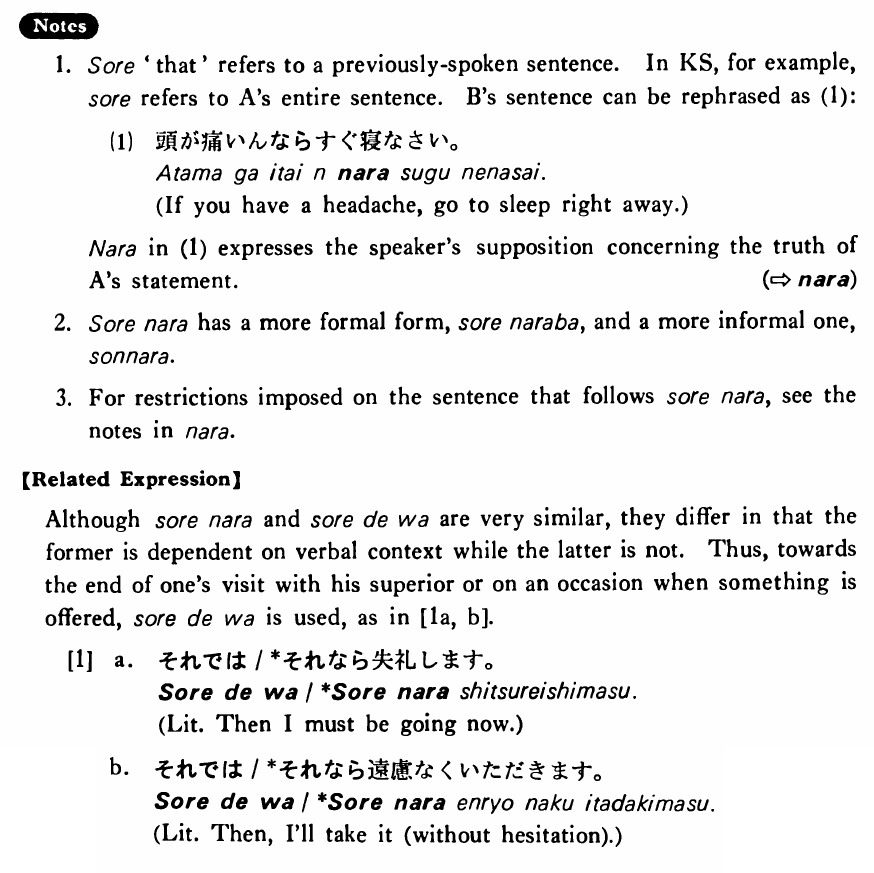
1. それ 'that' refers to a previously-spoken sentence. In Key Sentence, for example, それ refers to A's entire sentence. B's sentence can be rephrased as (1):
なら in (1) expresses the speaker's supposition concerning the truth of A’s statement.
(⇨ なら)
2. それなら has a more formal form, それならば and a more informal one, そんなら.
3. For restrictions imposed on the sentence that follows それなら, see the notes in なら.
【Related Expression】
Although それなら and それでは are very similar, they differ in that the former is dependent on verbal context while the latter is not. Thus, towards the end of one's visit with his superior or on an occasion when something is offered, それでは is used, as in [la, b].
[1]